

Our Manifesto: What we stand for, what we’re building, and what we hope to transform in the lives of dogs and their humans.
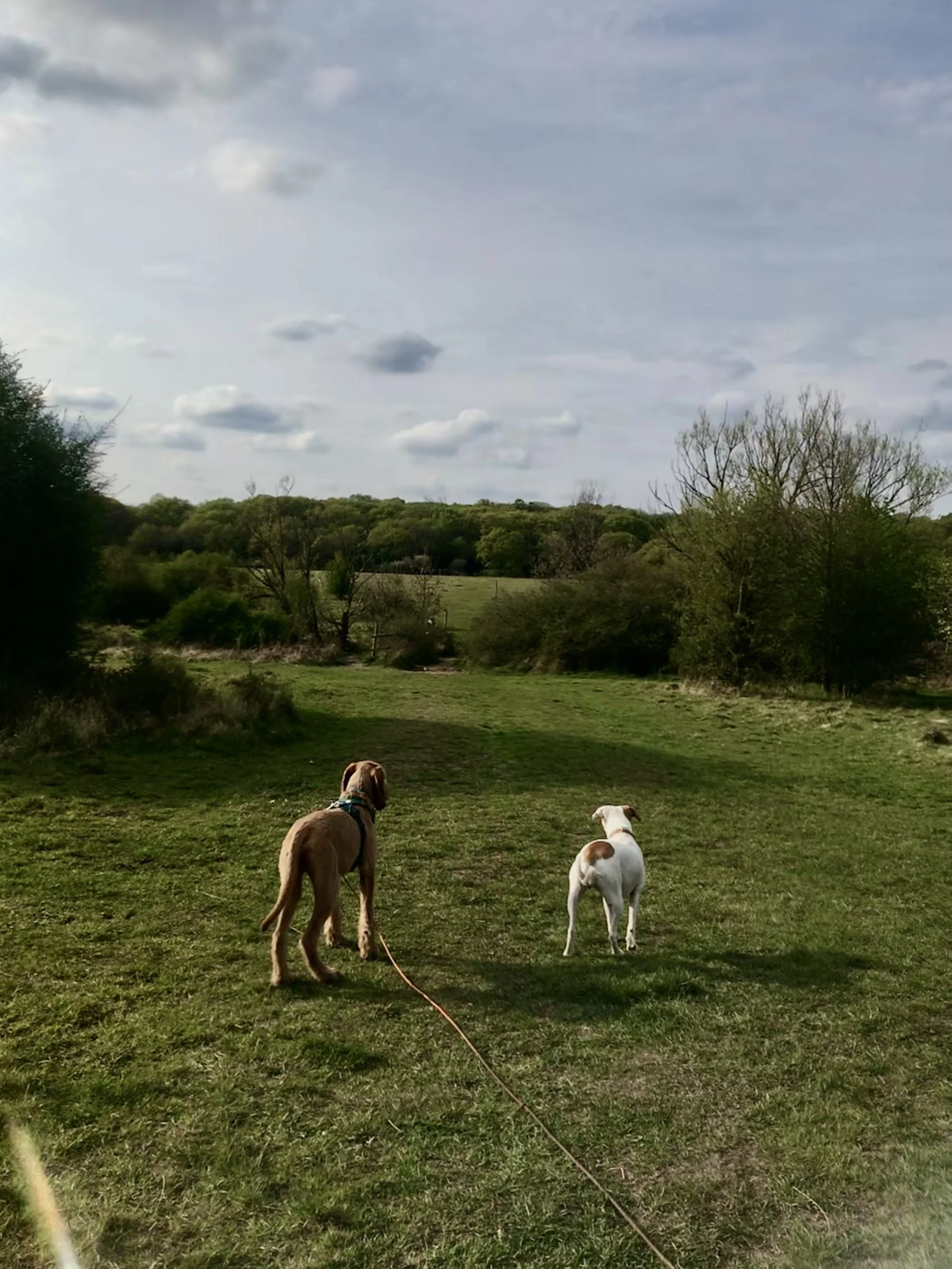
The heart of our approach
In many settings, traditional day care and large group walks can become overwhelming and overly stimulating experiences for dogs. Over time, we have heard countless accounts of dogs developing unwanted behaviours in busy pack environments, or becoming increasingly stressed and anxious as a result of constant arousal and limited opportunity to truly rest.
In some cases, this stress manifests in unexpected displacement behaviours or signs of deep unfulfillment that are often misunderstood.
There are several reasons this happens. Dog body language and behaviour are frequently misread or anthropomorphised, and within an unregulated industry, a love of dogs alone can be mistaken for the knowledge and experience required to care for them well. Without clear structure, calm and loving leadership, and thoughtful supervision, group environments can become unruly—making it difficult for dogs to switch off, regulate themselves, or feel safe.
Persistent barking, humping, tension around resources, or escalating play can all be signs of stress rather than enjoyment, yet they are often interpreted simply as tiredness or excitement. Even familiar signals, like a wagging tail, can hold many different meanings depending on context, posture, and emotional state, which is why it is so important to have enough resources to enforce balance and meet every need, so that these subtleties are spotted.
At Charlie’s, we choose to begin from an understanding of dogs as the species they are. From this perspective, “challenging behaviours” are rarely faults within the dog, but rather reflections of the environments and expectations created around them. Our role, therefore, is to thoughtfully shape experiences that set them up for success and allow them to feel safe, happy and fulfilled.
Before any dog joins us, they are welcomed through a careful and unhurried assessment period. This begins with solo walks, allowing a genuine bond to form between dog and handler while ensuring the experience feels calm and manageable for everyone involved. During this time, the dog can begin to understand gentle expectations, while we gain insight into who they are in the world—how they move, what captures their attention, and how they respond to everyday distractions and stimuli.
This is followed by a small, intentional introduction walk alongside Charlie, whose steady and balanced nature makes her an exceptional first companion for newcomers. As a natural role model, she offers other dogs the opportunity to observe, mirror, and settle into calmer patterns of behaviour. Equally, her response to each dog provides a valuable understanding of their energy, temperament, and any areas that may require additional care or support.
When a dog is ready, we begin a gradual acclimatisation into the daycare environment. Introductions to the existing pack are slow and considered, with the dog supported on a light house lead during the early stages. This helps them learn how to move respectfully within the space, while allowing us to redirect unwanted behaviours promptly, quietly and without stress. The result is a calmer, more rewarding experience that sets each dog up for long-term success. The pace of this process is always led by the individual dog—some move forward quickly, others take more time, and both are met with equal patience and care.
Each day follows a clear yet flexible rhythm, shaped around the needs of the dogs in our care. Time is thoughtfully balanced between structured or exploratory walks, restorative rest, and enriching activities such as light obedience work and food-based puzzles. This steady flow supports regulation, fulfilment, and genuine wellbeing—allowing dogs not simply to expend energy, but to feel settled, content, and at ease.
For safety, balance, and emotional stability within the group, dogs are not given off-lead freedom until their recall is truly reliable. Beyond physical safety, this boundary helps preserve a sense of cohesion within the pack, preventing the fragmentation that can arise when dogs move too far from the shared environment and energy.
Because these principles shape everything we do, any difficulty within them is understood not as failure, but as information—an invitation to look more closely at what a dog may need in order to feel secure, understood, and successful. Behaviour issues are often a symptom of a need that isn’t being met, boundaries not being enforced, or trauma from a bad experience, rather than an undesirable trait.
While dogs may spend meaningful time in our care, their humans remain the centre of their world. True progress, therefore, depends on partnership. Our guidance is always offered with respect and openness, yet consistency between home and day care is essential. Without it, dogs can become uncertain about what is expected of them, leading to confusion, stress, or unreliability—outcomes that stand in direct opposition to the calm clarity we seek to create.
For this reason, we work closely and compassionately with each family, supporting both dog and human in moving toward greater understanding, trust, and harmony together.

What we’re building
At the moment, there is a very visible divide within the dog training world. The conversation is often framed as balanced training versus positive-reinforcement-only training. This debate goes far beyond tools such as harnesses, haltis or slip leads; it reaches into ethics, morals, and each group’s understanding of how dogs learn and perceive the world.
For many owners, this can be extremely confusing, exhausting and unhelpful. It can feel as though choosing how to train your dog means choosing a side in a moral argument, which, unless you work in the industry or have done extensive reading on it, can be hard to understand in the first place.
At Charlie’s, we reject dogmatic approaches to dog training, behaviour, and psychology. We do not believe that rigid allegiance to one method serves the individual dog in front of us. Every dog has their own temperament, history, sensitivities, and thresholds. To honour that properly, we believe it is important to have full access and understanding of all learning quadrants available to us. Applied thoughtfully, appropriately, and with compassion, rather than prioritising our own emotional comfort or ideological preferences.
Dogs are not humans. They experience and interpret the world differently from us. Truly respecting them means meeting them as the species they are, not projecting human frameworks onto their behaviour.
What we are building is a community that steps away from online division and towards informed, respectful conversation. A space where differing opinions can co-exist without hostility, and where the shared aim remains the same: improving the quality of life for dogs. In a culture of internet forums, loud opinions, and polarised commentary, we want to create room for curiosity, dialogue, and learning — so that we can become the most well-informed humans possible for the dogs in our care.
We are still a young but steadily growing business, and one of our ambitions is to engage with other small businesses across the South East London community — whether they align perfectly with our values or not. Through events, Q&A sessions, community dog walks, small competitions, and shared spaces, we hope to bring people together around a mutual respect for dogs as a species.
Eventually — and yes, we recognise how ambitious this sounds — we would like to engage with organisations campaigning for regulation across all areas of the dog industry: training, breeding, grooming, care — everything.
This currently is not the case, and that lack of structure allows for inconsistency, misinformation, and in some cases, harm. A more cohesive standard of understanding would mean fewer dogs entering shelters, fewer names on euthanasia lists, and fewer powerful breeds placed in the wrong hands.
We want to help redefine the industry.
What Sets Us Apart
Dogs come first in every service we provide
We do not subscribe to rigid training camps or online trends. Every dog is an individual, and their temperament, history, and sensitivities matter more than any single methodology. Our approach is grounded in a deep understanding of how dogs learn as a species, applied thoughtfully and responsibly to the dog in front of us. It’s not about proving a point - it’s about doing what truly supports the dog’s wellbeing.
Long-Term Relationships
Some of the dogs in our care have been with us for years, growing alongside us through different stages of their and our lives. This allows for deep consistency and genuine trust that develops over time. Rather than offering short-term supervision, we focus on lasting relationships that support each dog’s well-being in a meaningful and enduring way. For us, care is not temporary — it is a commitment.
Intentional care
Nothing we do is accidental or rushed. Every walk, introduction, period of rest, and moment of guidance is considered in relation to the individual dog and the wider balance of the pack. We move at a pace that supports the individual, and the overall strength and cohesion of the pack.